About
Eusebiu Moldovan (Seb)
Software engineer, Computer Science graduate and maker of small games and apps.
On this page
Background

Born in the countryside of Romania, I moved to the UK in 2016 and I've been living here ever since. I picked up programming early on, studied Maths, Physics and Computer Science at A-Level, and went on to graduate from the University of Liverpool with a Bachelor's in Computer Science.
I'm always on the lookout for great opportunities to learn from others, develop my skills and gain experience working as a software engineer — from internships to hackathons like ICPC UK & Ireland.
Outside of code
Aside from Computer Science, I've always been interested in Mechanical Engineering, but chose not to pursue it as a career. I've always preferred Maths and Science over English and other subjects — that was evident early on, and again when choosing a degree.
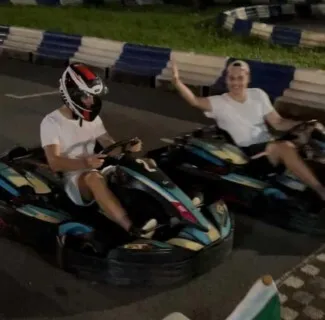
I fill most of my spare time either learning more about those interests, or just being a young adult: going out, playing video games, watching football and racing go-karts. Early in the pandemic I also volunteered with the National Citizen Service, helping raise £300+ for a local food bank.
Education & experience
-
Oct 2024 – Present
Junior Software Developer
bet365, Manchester
Currently working at bet365 as a junior software engineer, working on the gaming side, making front end chnages in .net and later in react, sql scripts to add new content and site rules for new regulations, and Go Lang work in regards their micro service back end architecture, for various endpoints and data handling, now deployed to Google Cloud.
-
Jun – Sep 2023
Summer Intern
Caplin Systems, London
Caplin builds web trading and financial tools for banks. In a team of three I worked on a proof-of-concept dashboard analysing trading and client data across 6+ widgets — React and TypeScript on the front end, Java and Spring Boot on the back end — and picked up CI/CD, agile workflows and automated testing along the way.
-
2021 – 2024
BSc Computer Science — 2:1
University of Liverpool
23 modules covering both the theory and practice of computer science, 4+ personal and group projects, and a dissertation. I also sat on the Student Liaison Committee, raising issues on behalf of CS students and helping at department open days.
-
2019 – 2021
A-Levels in Maths, Physics & Computer Science
Whitmore High School, London
Studied through Covid, with a final-year project that became my first game. Hero Knight →
University modules
Each semester had four modules, eight a year. These are the ones I enjoyed most or found most useful.
Year 1
-
COMP105
Programming Language Paradigms
- Focus on functional programming using Haskell
- Had to relearn basics such as recursion because of the functional nature of the language
- Widened my view of the different kinds of programming languages, though it's not a paradigm I've used since
-
COMP108
Data Structures and Algorithms
- Explored arrays, queues, stacks, linked lists and different sorting algorithms, comparing their efficiency
- Mostly theory driven, but these are very useful notions in computer science
- The knowledge applied to a lot of problems I came across during my studies
-
COMP116
Analytic Techniques for Computer Science
- A theory-heavy module with complicated new concepts, some of which took time to fully grasp
- Complex numbers and their applications, spectral methods, calculus, linear algebra and more
- They proved their usefulness in later projects and modules
-
COMP122
Object Oriented Programming
- One of my favourite modules: lots of Java coding, exploring concepts I found really useful
- Hierarchies of related classes, polymorphism and GUIs, all put into practice
- Led me to other interesting projects and made future modules easier to understand
Year 2
-
COMP202
Complexity of Algorithms
- Asymptotic notation, AVL trees, different sorting algorithms and cryptography
- Included a coding assignment that put the material into practice
- Helps with general coding problems, especially in competitions like ICPC
-
COMP208
Group Software Project
- Building a piece of software in a team of 5–6 people
- Our idea was an interactive game that helps children learn maths
- It has a full authentication system, menus, settings, gameplay and a leaderboard
Built: Hot Air!
-
COMP222
Game Design
- Went deeper into game design practices and structures, building on my A-Level and group project games
- Game engines, renderers, geometry, vector arithmetic and transformations, virtual agents and more
- I made a game heavily inspired by the classic Asteroids
Built: Icarus Initiative
-
COMP228
App Development
- A new area for me, focusing on iOS and how mobile software differs from (and resembles) desktop
- Used Swift and Xcode to develop several iOS apps
- The most enjoyable module of my degree: I learned a lot and had fun coding with classmates in the Mac lab
Built: Fortuna, New Brighton Murals
Year 3
-
COMP305
Biocomputation
- Neurons, neural networks, perceptrons, learning and genetic algorithms
- Went into a lot of detail on concepts that were hard to grasp at first
- Purely theory, but it helped in other modules
-
COMP329
Autonomous Mobile Robotics
- Having never done robotics before, this was an intriguing area to study
- Focused mostly on intelligent agents in a virtual environment, similar to game agents
- Using sensors and controlling motors, letting an AI make decisions for different scenarios
-
COMP338
Computer Vision
- Continuing the AI theme: how visual data can be analysed and interpreted
- Classifying images, applying filters, selecting training data and more
- Included a few smaller projects using Python and PyTorch
-
COMP343
Computer Forensics
- Forensic processes and the law around collecting digital evidence, with plenty of essays
- Carried out similar procedures with tools like Kali Linux and Autopsy, writing up the findings
- Read recent academic papers on forensic processes, looking for ways to improve them